

Parabens in Skincare: What They Are and How to Read Labels
Parabens are preservatives. They keep water-based skincare and makeup from growing bacteria and mold. The FDA states it does not have information showing that parabens, as used in cosmetics, affect human health, and its scientists keep reviewing the studies. Some shoppers still avoid them, and “paraben-free” is a common label claim. This guide covers what parabens are, what the evidence says, what the label means, and how to choose a product that fits your skin.
TL;DR
- Parabens are a family of preservatives, mainly methylparaben, ethylparaben, propylparaben and butylparaben. They appear by name on U.S. ingredient lists.
- The FDA reports no information showing an effect on human health from parabens as used in cosmetics. Research on the topic is ongoing.
- “Paraben-free” means only that parabens are left out. It does not say what preservative replaced them, or whether the product suits sensitive skin.
- “Clean beauty” has no universal definition. Check the full ingredient list and patch test new products.
- Choose by your own skin: known allergens, fragrance, and how the formula behaves over several days.
Table of Contents
- What parabens are and why skincare uses them
- How to spot parabens on an ingredient list
- What “paraben-free” means
- Are parabens bad? What the evidence says
- Why some people avoid parabens
- What replaces parabens, and why it matters
- Paraben-free versus clean beauty
- Our perspective
- How to choose a product for your skin
- Shop Maison Dovellé
- FAQ
- Sources
What parabens are and why skincare uses them
Parabens are a group of related chemicals. According to the FDA, they are commonly used as preservatives in cosmetics to prevent the growth of harmful bacteria and mold, which protects both the product and the person using it. The most common are:
- Methylparaben
- Ethylparaben
- Propylparaben
- Butylparaben
WebMD also lists isopropylparaben and isobutylparaben among the types found on U.S. labels, and notes that parabens have been added to cosmetics since the 1920s.
Any product that contains water needs protection. Moisturizers, serums, foundations, mascaras and cleansers all give microbes a place to grow, and every jar or tube is opened with fingers, brushes or applicators over weeks or months. A preservative system is not optional. The only question is which one.
Where parabens show up
Parabens can appear in moisturizers, shampoos, shaving gels, makeup, spray tan products and personal lubricants. Oil-only and powder formulas contain little or no water, so they depend less on preservatives, though many products of that kind still include some.
How to spot parabens on an ingredient list
Cosmetics sold in the U.S. must list their ingredients. Parabens are easy to find because the names end in “paraben.”
- Turn the package over, or open the ingredient list on the product page.
- Scan for any word ending in “paraben.”
- Check the end of the list. Preservatives are usually near the bottom, because they are used in small amounts.
- Note which preservative is listed instead, if no paraben appears.
Ingredients appear in descending order of amount, down to the ones present at 1% or less, which may be listed in any order. That is why a preservative can sit anywhere in the lower half of a list.
What “paraben-free” means
“Paraben-free” is a marketing claim. It says that no parabens were added to the formula. It says nothing else.
- It does not say the product is preservative-free. A water-based product still needs a preservative.
- It does not say which preservative was used.
- It does not say the product is hypoallergenic, fragrance-free or suited to sensitive skin.
- It is not a regulated seal. The FDA does not approve cosmetic ingredients before sale, apart from color additives.
The same regulatory point applies to every cosmetic. Under federal law, cosmetics and their ingredients, other than color additives, do not need FDA approval before going on the market. It is still illegal to sell a cosmetic that is adulterated or misbranded. In practice, a product must be safe for consumers when used as the label directs.
Are parabens bad? What the evidence says
The answer depends on which question is asked. Regulators, safety panels and laboratory studies address different things.
Regulators and safety panels
- FDA. It has no information showing that parabens as used in cosmetics affect human health, and it continues to review published studies (FDA).
- Cosmetic Ingredient Review (CIR). This expert panel reviewed parabens in 1984 and found methylparaben, ethylparaben, propylparaben and butylparaben safe as used, and later added isopropylparaben and isobutylparaben (MDedge). Its 2020 amended assessment concluded that 20 of 21 parabens are safe in current use and concentration when the total parabens in a formula do not exceed 0.8%. Data were insufficient for benzylparaben.
- European SCCS. Its public summary says animal studies show generally low toxicity and no cancers, and that hormone-like activity is thousands to millions of times weaker than natural hormones.
- GAO. The U.S. Government Accountability Office notes that parabens have been linked in some studies to endocrine problems. It also notes that the 2022 cosmetics law did not give the FDA authority to approve cosmetics for safety before sale.
Laboratory research
A 2025 peer-reviewed study tested parabens on human skin cells in the lab. It found that butylparaben and benzylparaben were far more toxic to keratinocytes than methylparaben and ethylparaben. At high concentrations, butylparaben and benzylparaben also slowed wound healing in cell models. These are cell experiments, not results from people using finished products. They do explain why the longer-chain parabens draw more attention than methylparaben.
Allergy
Parabens are an uncommon cause of skin allergy. One review reports that paraben mix allergy averages about 1%, and that the American Contact Dermatitis Society named parabens its non-allergen of the year in 2019.
What this adds up to
The regulatory position and the research debate are separate. Authorities have not found evidence of harm at the levels used in cosmetics. Researchers continue to study hormone activity and exposure. Many people choose to avoid parabens as a precaution, and that is a legitimate preference. A clear ingredient list lets you act on it.
Why some people avoid parabens
Parabens are discussed mostly because of the hormone question. A 2025 review in Practical Dermatology describes paraben-free products as marketed to avoid potential endocrine-disrupting preservatives, while also calling parabens among the most studied preservatives in cosmetics.
Reasons shoppers give for choosing paraben-free:
- Wanting to limit total exposure across many daily products.
- Preferring a shorter, simpler ingredient list.
- Following guidance from a dermatologist or doctor for a personal health reason.
- Buying for children or during pregnancy, and choosing caution.
These are personal decisions. For a specific medical situation, such as pregnancy, hormone-related conditions or a known allergy, ask your doctor or dermatologist. Our guide to pregnancy skincare for sensitive skin covers ingredients to review with a clinician.
What replaces parabens, and why it matters
Removing parabens means choosing another preservative. Some alternatives are well tolerated. Others cause more reactions.
A 2021 review by Liszewski and colleagues found limited evidence that parabens in personal care products pose a health risk. It also linked the move away from parabens to a rise in allergic contact dermatitis from isothiazolinone preservatives, which are more allergenic. A 2025 scoping review makes the same point: excluding parabens has in some cases led to substitution with more allergenic compounds.
The wider trend is visible too. A 2024 paper notes a 2.7-fold increase in allergic contact dermatitis from personal care products between 1996 and 2016.
The practical lesson: do not stop at the front-of-pack claim. Read the preservative at the bottom of the list, and note any ingredient that has caused a reaction before.

Paraben-free versus clean beauty
The two terms overlap but are not the same.
| Term | What it describes | Defined by a standard? |
|---|---|---|
| Paraben-free | No parabens added | No regulated seal |
| Clean beauty | A brand’s own list of excluded ingredients | No universal definition |
| Fragrance-free | No added fragrance | Check the full list for masking scents |
| Cruelty-free | No animal testing, per the brand or a certifier | Depends on the certifier |
Practical Dermatology describes “clean beauty” as a branding tool with no universally accepted definition. It works by ingredient exclusions rather than a clinically meaningful distinction. A clean label tells you what a brand left out. It does not guarantee that nothing in the formula can irritate.
A 2024 analysis of 313 moisturizers, cleansers and sunscreens sold in a clean skincare category found that tocopherol was the most common allergen in moisturizers (73.8%) and sunscreens (63.8%), and alkyl glucosides in cleansers (46.7%). Those are common, often useful ingredients. The point is that “clean” and “allergen-free” are different claims, and sensitive skin needs the second one checked by hand.
Our perspective
Maison Dovellé formulates for sensitive skin. Our approach pairs clean and cruelty-free ingredients with nourishing natural ones, and we design makeup to hydrate and care for skin, not only cover it.
Our view on parabens is practical. A single ingredient name does not decide whether a product is right for you. The full formula does: the preservative system, the fragrance, the texture, and how your skin responds over days.
That is why we publish guides on skincare ingredients to avoid for sensitive skin and on patch testing. Read the ingredient list on any product, ours included, and introduce it gradually.
We want customers to get visible results in hydration and skin texture without trading away their health or their ethics. Our collections are built around that aim.
Miranda Carmichael
How to choose a product for your skin
Use this checklist at the shelf or on a product page.
- Decide your goal. Avoiding parabens, avoiding known allergens, or both.
- Read the whole list. Find the preservative, then the fragrance and any ingredient that has bothered you before.
- Check for fragrance. Fragrance is a frequent trigger. See our fragrance-free skincare checklist.
- Patch test. Apply a small amount to the inner forearm or behind the ear. Our patch test guide gives the timing: 48 to 96 hours, then 7 to 10 days.
- Introduce one product at a time. If a reaction happens, you will know the cause.
- See a dermatologist for persistent reactions. Patch testing in a clinic can identify the specific preservative or fragrance involved.
If you are repairing a compromised barrier, a simple routine helps. Our skin barrier repair routine lays out the steps.
Makeup follows the same rules
Foundation, mascara and liquid lip products contain water or are applied near the eyes and mouth, so the preservative system matters. Our guide to clean makeup for sensitive skin explains how to patch test base and eye products before regular use.
Shop Maison Dovellé
Maison Dovellé sells clean, cruelty-free eye care, lip care, makeup and skincare accessories formulated for sensitive skin with nourishing natural ingredients. Start with the FACE collection for tinted moisturizers and foundation, the EYES collection for eye products, or the LIPS collection.
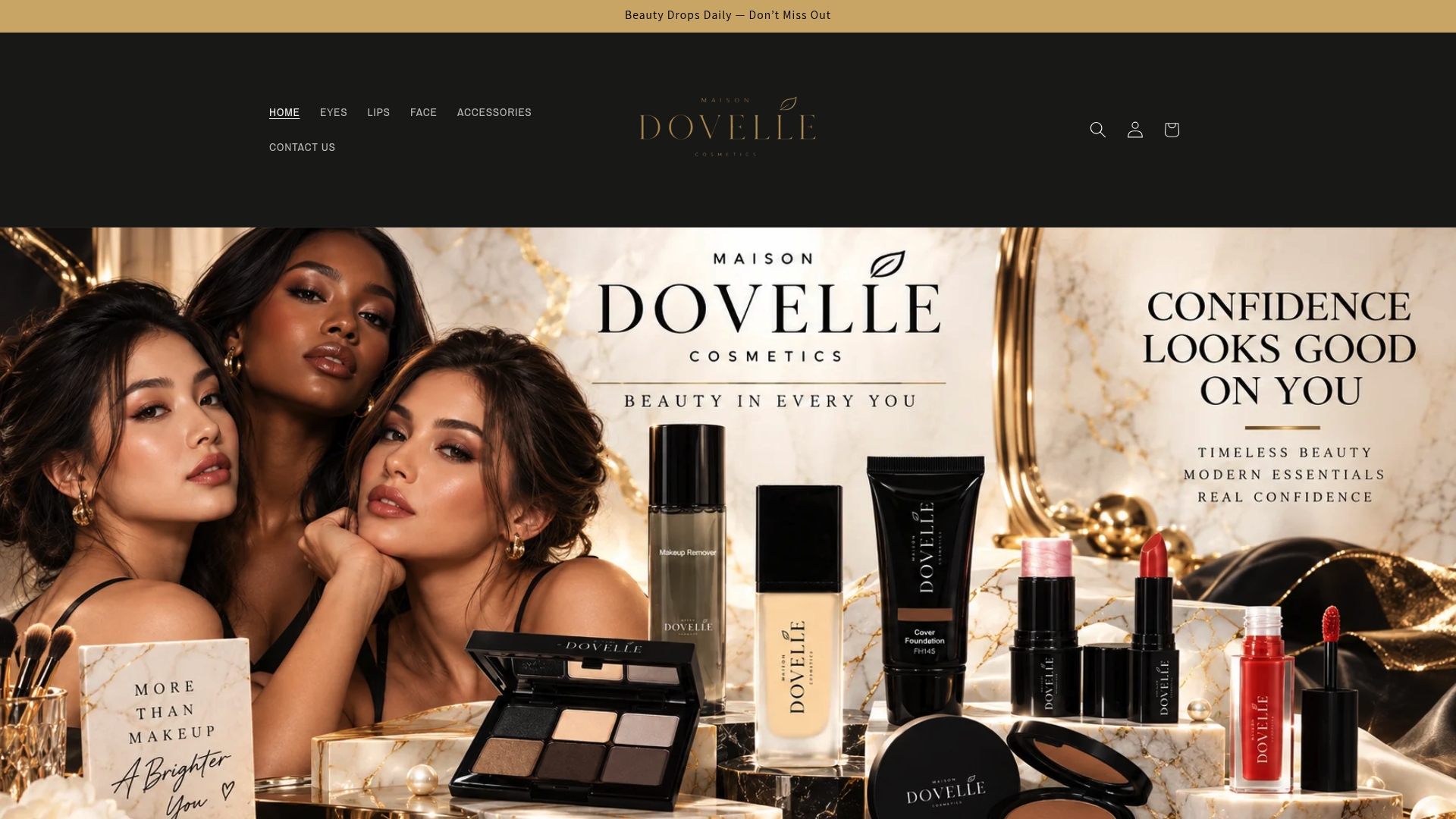
Each product page lists its ingredients. Compare them against your own list of ingredients to avoid, and patch test before regular use.
FAQ
What does paraben-free mean?
It means no parabens were added to the formula. It does not mean the product has no preservative, and it is not a regulated seal. Check the ingredient list to see which preservative is used instead.
Are parabens safe for skin?
The FDA says it has no information showing that parabens as used in cosmetics affect human health. The CIR panel found 20 of 21 assessed parabens safe at a combined level up to 0.8%. Research continues, and anyone with a specific health concern should ask a doctor.
Why avoid parabens?
Most people who avoid them cite hormone-related concerns raised in some studies, or a preference to limit exposure. Others have a documented allergy, which is uncommon. If your reason is a reaction, a dermatologist can test for the cause.
Is paraben-free the same as clean beauty?
No. Paraben-free describes one ingredient group. Clean beauty has no universal definition and varies by brand. A product can be paraben-free and still contain ingredients that irritate sensitive skin.
Do paraben-free products still need preservatives?
Yes, if they contain water. Without a preservative, bacteria and mold can grow. Reviews show that some substitutes, such as isothiazolinones, cause more allergic reactions, so read which one a product uses.
Sources
- Parabens in Cosmetics, FDA
- What You Should Know About Parabens, Cleveland Clinic
- Parabens: What You Should Know, WebMD
- Amended Safety Assessment of Parabens as Used in Cosmetics, CIR (2020)
- No Sulfates, No Parabens, and the No-Poo Method, MDedge
- Parabens used in cosmetics, European Commission SCCS
- Cosmetic Safety, GAO-24-105542
- Assessment of the toxic effects of parabens, PMC (2025)
- A perspective on the safety of parabens as preservatives, PMC
- Clean Beauty in Dermatology, Practical Dermatology (July 2025)
- Review of aluminum, paraben, and sulfate product claims, PubMed
- Is Clean Truly Clean? Allergenic Compounds in Clean Beauty, JSSC (2024)