

4 Checks to Verify Leaping Bunny Certification Using Official Rules
Leaping Bunny certification means an independent program has verified that a company and its suppliers have committed to a fixed cut-off date for animal testing, with no new testing after that point. It covers ingredients, formulations, and finished products, backed by supplier declarations and outside audits, not just a brand’s own word. To confirm a brand’s current status, check the Leaping Bunny Compassionate Shopping Guide directly.
TL;DR:
- Certification depends on a fixed, unchanging cut-off date for animal testing that applies to every ingredient and supplier across the entire supply chain.
- Companies must provide signed declarations from all suppliers and undergo independent audits to validate compliance, with missing declarations being the most common delay.
- There are no application fees for US and Canadian companies, but larger firms pay for their own audits, which can influence certification timelines.
- Retailers should verify current certification status through the official Leaping Bunny Guide instead of relying solely on product logos.
- Ongoing compliance requires annual recommitment with updated declarations and audits, with failure to do so leading to temporary removal from the list.
Table of Contents
- What the Leaping Bunny Standard requires
- How a company earns Leaping Bunny certification
- Who pays, and how long certification takes
- How to verify a brand while you shop
- What recommitment and audits enforce over time
- Where certification stands apart from bans and self-declared claims
- Maison Dovelle’s approach to cruelty-conscious beauty
- Why independent verification matters
- Shop cruelty-conscious beauty with Maison Dovelle
- Sources
- FAQ
What the Leaping Bunny Standard requires
The Standard rests on a small set of firm rules. Once a company sets its fixed cut-off date, that date does not move: no animal testing may occur for the company or its suppliers after it, according to the Leaping Bunny User Guide. Every ingredient supplier and manufacturer must sign a Declaration of Raw Material Compliance or a Declaration of Product Compliance confirming they meet the same rule.
- A fixed cut-off date applies to the company and every supplier, permanently.
- Declarations of Raw Material Compliance and Declarations of Product Compliance cover every ingredient and finished product.
- A supplier-monitoring system tracks changes across the supply chain on an ongoing basis.
- Independent audits check documentation, and annual recommitment keeps the listing active.
Missing declarations are the most common reason applications stall, since the requirement runs company-wide rather than product by product.
How a company earns Leaping Bunny certification
A brand starts by creating a company page, then works through a seven-section application labeled A through G, per the Leaping Bunny User Guide. Each section builds toward the same public listing shoppers eventually search.
- Section A sets the fixed cut-off date, the anchor for everything that follows.
- Later sections collect company policy answers covering testing practices and corporate structure.
- Supplier and manufacturer information gets logged so declarations can be requested from every party in the chain.
- Each supplier and manufacturer returns a signed declaration confirming compliance.
- Once every declaration is in hand, the brand listing goes live with an option to license the logo.
Pro Tip: Applicants who contact suppliers early and track responses in a simple spreadsheet tend to clear the declaration stage far faster than those who wait for replies to trickle in.
Supplier nonresponse is the recurring bottleneck, according to the Company FAQ, which is why a clear follow-up plan matters more than the paperwork itself.

Who pays, and how long certification takes
There is no fee to apply or to be listed for companies based in the US or Canada, per the Company FAQ. Logo licensing is optional and tiered by revenue, and audit costs follow the same logic.
- Application and approval carry no charge for US and Canadian companies.
- Logo license fees scale with a company’s gross annual sales.
- Leaping Bunny covers audit costs for companies under $10 million in gross annual sales.
- Companies at $10 million or above commission and pay for their own audits.
Timelines vary mostly with supplier cooperation rather than with the certifying body’s pace. A brand can be fully compliant and still not display the logo, since licensing is optional, so a missing logo on packaging does not mean a brand is unlisted.
How to verify a brand while you shop
Checking a claim takes less time than reading the ingredient panel.
- Open the Leaping Bunny Compassionate Shopping Guide or its companion app and search the brand name directly.
- Confirm the listing shows current status rather than a lapsed or historical entry.
- Compare any logo on the packaging against the licensed mark shown on the official listing.
- Contact Leaping Bunny or the brand directly when a product’s status is unclear.
A logo alone is not proof. The listing is the record, and it updates as recommitment and audit results change.
What recommitment and audits enforce over time
Certification is not a one-time badge. Companies must recommit every year, and according to the Recommitment FAQ, a brand that fails to complete recommitment with all declarations within two months of the deadline can be unpublished until compliance is shown again.
- Annual recommitment requires resubmitting declarations across the current supply chain.
- Independent audits sample transactions and documents to confirm the supplier-monitoring system works in practice.
- Companies with $10 million or more in gross annual sales fund their own audits.
- Missing the two-month recommitment window results in temporary unpublishing, protecting shoppers from relying on outdated status.
Leaping Bunny publishes which companies successfully recommitted, so a current listing reflects an active check, not a lapsed formality.
Where certification stands apart from bans and self-declared claims
Legal testing bans restrict a company’s own testing but often say nothing about ingredient suppliers, contract manufacturers, or products sold in markets without such bans. That gap is exactly where certification does more work.
- Legislative bans typically cover finished products in one jurisdiction, not the full supply chain.
- Leaping Bunny’s fixed cut-off date, supplier declarations, audits, and annual recommitment apply company-wide, per The Leaping Bunny Difference.
- Programs built on self-declaration rely on a brand’s own statement, without outside audits or supplier sign-off.
- Verification against self-declaration is the core distinction shoppers should weigh when comparing marks.
A large share of consumers now say cruelty-free status influences what they buy, based on data from Leaping Bunny. Independent verification is what separates a documented claim from a marketing line.
Maison Dovelle’s approach to cruelty-conscious beauty
Maison Dovelle builds its beauty essentials around ingredients meant to hydrate and nourish, not just cover concerns like dry or dull skin. Products such as Bounce Boost Mousse pair skincare with makeup coverage rather than treating them as separate categories. Users sometimes notice changes in skin texture and hydration, reflecting a focus on skincare in formulation.

Why independent verification matters
Shoppers deserve proof, not a logo taken on faith. Independent audits and annual recommitment remove the guesswork that self-declared claims leave behind, which is why Maison Dovelle treats verification as a baseline for evaluating any cruelty-free claim, including its own. Check the Compassionate Shopping Guide before trusting a logo on a shelf.
— Miranda Carmichael
Shop cruelty-conscious beauty with Maison Dovelle
The brand formulates products using clean, cruelty-free ingredients with the aim of supporting skincare needs without compromising on health or ethics.
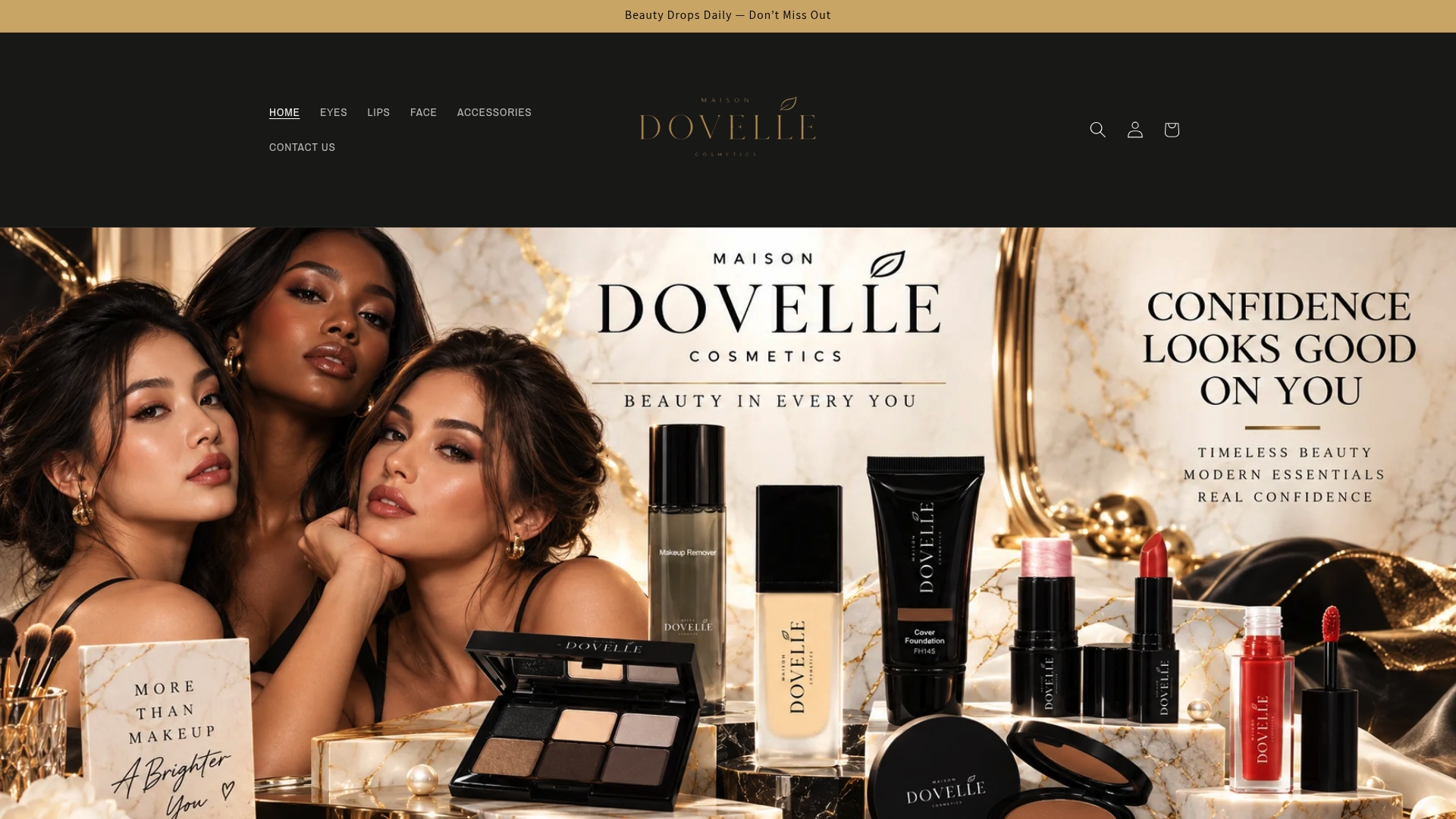
- Browse EYES for products like Khol Eyeliner - Emerald and Eyeshadow Palette - Sweet Almond.
- Shop LIPS for Lip Liner - Deep Coral, Lip Liner - Antique Rose, and Matte Lip Stain - Deep Burgundy.
- Explore FACE for Men’s Face Moisturizer, Glow Mask, and Anti-aging Rose Gold Oil.
Always confirm a product’s own certification status against the official Leaping Bunny listing rather than assuming it from a category alone. Start browsing the full collection to find your next cruelty-conscious pick.
FAQ
How much does it cost to get Leaping Bunny certified?
There is no fee to apply or be listed for companies based in the US or Canada, according to the Company FAQ. Logo licensing is optional and priced by gross annual sales, and companies earning $10 million or more also pay for their own required audits.
How does Leaping Bunny differ from PETA’s cruelty-free program?
Leaping Bunny requires supplier declarations, a fixed cut-off date, and independent audits before and after listing, per the Leaping Bunny User Guide. Programs built primarily on self-declaration ask a brand to confirm its own compliance without the same third-party audit and annual recommitment structure.
Is Tree Hut Leaping Bunny certified?
Brand-specific certification status changes over time as companies apply, recommit, or lapse, so the only reliable source is the current Compassionate Shopping Guide on the Leaping Bunny site. Search the brand name directly there rather than relying on packaging alone.
What brands are Leaping Bunny certified?
As of 2026, Leaping Bunny lists over 2,300 certified brands in its Compassionate Shopping Guide, spanning skincare, makeup, and personal care. The full, current list is searchable by brand name on the official site, since new companies are added and others are unpublished as recommitment status changes.
Can a brand keep its Leaping Bunny status after being acquired?
A brand acquired by a non-certified parent company can remain listed only if it operates as a standalone subsidiary with a separate supply chain and continued compliance, according to Leaping Bunny’s FAQ. Leaping Bunny notes parent-company status in the Guide so shoppers can see the full ownership picture.